
THE CONCEPT OF TIME.
THE CONCEPT OF TIME.
But the conception of time for the Earth physicist differs on a fundamental level from that of psychobiologists. You see Time as a dimension, at least it is thus accepted by the followers of EINSTEIN's relativity theory.
Our concept of TIME undoubtedly presents new ideas which are unknown for you. First of all we cannot regard Time as a dimension or continuum, as you do. It is not that time is quantified, but one cannot conceive a moment as a point on the axis of time. The interval dt, although it can tend towards zero, could never be perceived as small as we would like to.
There is another aspect to this question we wish to underline. You consider that the highest speed a subparticle in the WAAM (Cosmos) can reach is 299,780 km/h (speed of light) and you regard this speed as "CONSTANT ".
This is not a poor measurement. Indeed: it is this same speed that we recorded... within this same three-dimensional framework.
But all one needs to do is change framework or three-dimensional system so that this limiting Speed changes remarkably up to the point where the only reference which can reflect the change of axis is the measurement of this speed or constant, C.
We will thus have a family of values thus: C0 C1 C2 C3... Ci ..............Cn,
which extends from C0 = 0 (zero) to Cn = ¥(infinite),
each one representing a definite system of reference.
In the first case, (speed of light zero), definite phenomena that you associate with parapsychology are produced, such as for instance telepathic communication. The WAAM analysed under this three-dimensional system of reference has an absolute uniformity, you would say maximum Entropy (even if this state of MAXIMUM ENTROPY or DEGRADATION could occur in any system of reference where the speed of light is " NONZERO ").
In the borderline case of infinite speed of light, the WAAM can be considered as nonexisting, for one could compare it to an identification of every IBOZOO UU with itself, i.e. with only one IBOZOO UU which, as you know, does physically exist.
It is necessary that you understand that before continuing further, even if it is difficult to accept because of the logical reasoning to which you are accustomed.
If you imagine in space an infinite range of small spheres or small balls, each one of different colour and a different shade from the others, you will then have a rough image of the WAAM.
Imagine now that you locate two spheres of exactly the same colour. Your logical mechanisms would tell you that these two small balls are in different places, that they represent different entities. In short, they are two balls, and this plurality of spheres differentiated by colour fails miserably.
But if we translate this reasoning into the cosmos, if you locate two IBOZOO UU which were until now distinct since their " axes " (OAWOO) were directed in different directions, and if now you look at them in the perspective that both IBOZOO UU are equal; you will then have to use another type of reasoning dissociated from divalent logic and affirm that these " two " IBOZOO UU are " the same " IBOZOO UU.
Indeed: a pair of IBOZOO UU that appears different, in a system of reference, for instance a neutron and a pion, by changing reference axes, these two subparticles which in the other framework seemed very distant for the observer, belonging even to two different galaxies, must be regarded as the same IBOZOO UU in another three-dimensional system.
But the probability that this occurs for a pair of IBOZOO UU is practically zero when the new system of reference differs " angularly " very little from the former one.
Let us move away somewhat from the central question: we define an interval of time AT as a succession of IBOZOO UU from which the IOAWOO differ between each other by constant quantities (D59_FG26)

D59_FG26
That is, that we consider in an IBOZOO UU the four " axes " (OAWOO) (and once again drawing attention to the true concept of OAWOO) which we call OAWOO UXGIGII for it is they that represent the three-dimensional frame of reference (D59_FG27).
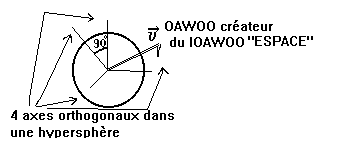
D59_FG27
OAWOO UXGIGII which in reality do not exist, for they are as conventional as a symbol, but they a tool for the mathematician to fix the position of the true OAWOO.
If the true OAWOO (U) oscillates inside this ideal framework, imagine now a new system of reference consisting of TWO OAWOO UXGIGII, each one of them forming a 90 ° angle with the four former ones (see D59_FG27).
This new framework of action of a real T (OAWOO) and those previously defined, respectively define SPACE and TIME D59_FG28:
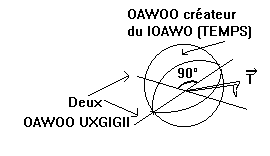
D59_FG28
You can see that the OAWOO (vector axes) V and T which define
SPACE AND TIME have different degrees of freedom. The first can cross IOAXOO
(Angle-Space) in three different directions which correspond to three typical
dimensions of SPACE, the second being restricted to moving on only one
plane.

D59_FG29
Two IBOZOO UU whose axes OAXOO T1 and T2 differ by an angle such
that there does not exist in the WAAM another IBOZOO UU between the two,
will define the smallest interval of TIME. We call this interval UIWIIOO
(INSTANT) (D59_FG29).
 |
Previous page |
Synopsis |
 |